Welcome to The Station. Cybersecurity research and early defense, made simple. Let our platform do the digging. You make the call.

NSS

See the evidence. And the head start.

NSS surfaces risky infrastructure early, shows the evidence behind every verdict, and puts our detection time beside the public listing time.

Look up an IP address or a domain.

Check tells you what NSS already knows, in a second. 3 a day.

Deep check looks again now and tells you why. Once a day.

One cookie remembers your display settings; unlocking more checks adds one that holds them. No tracking cookies or scripts; visits are counted from server logs. Privacy

try the API
curl "https://nsshq.com/api/v1/check?value=example.com"
curl "https://nsshq.com/api/v1/deep?value=example.com"

24 live ARTEX consoles beyond the FBI FLASH, and how to spot them. Read the paper, NSS-AX-01.

A companion to FBI FLASH-20261113-001, published 17 Nov 2026: the consoles, the fingerprint to detect them, and the reseller layer behind them.
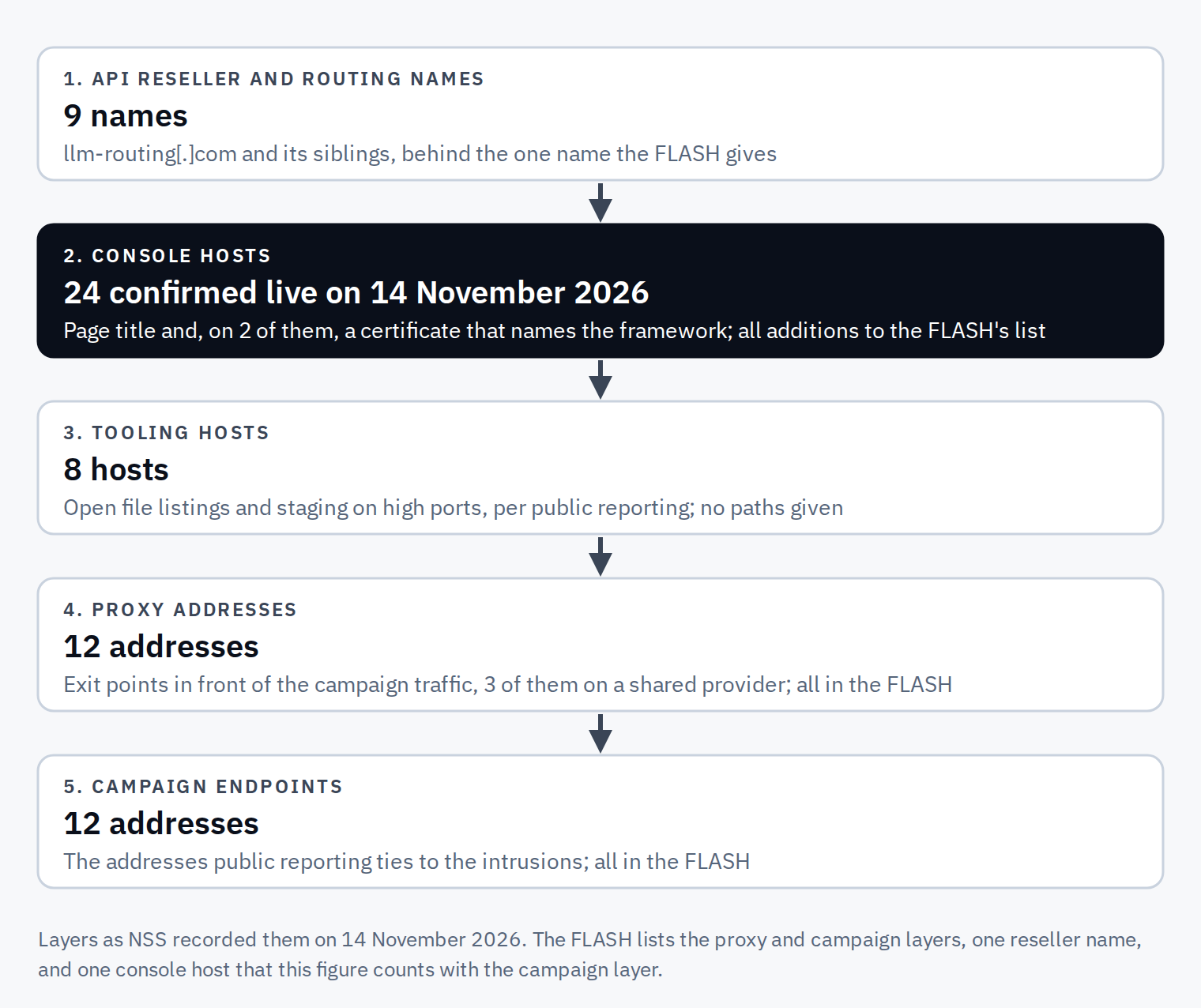
A five-layer diagram of the infrastructure in this paper: at the top the API reseller and routing names behind the one the FLASH gives; then the console hosts, 24 additional consoles confirmed active on 14 November 2026, two with a certificate that names the framework; then tooling hosts; then proxy addresses; then the campaign endpoints. The FLASH gives the proxy and campaign layers, one reseller name and one console host.
The layers this paper covers, building on the FLASH.
Detection2 signaturesTested

Two signatures carry the fingerprint: an alert on an HTTP response whose page title names the framework, and an alert on a certificate whose issuer organisation names the framework.

Both were validated against NSS's stored readings of the 24 consoles from 14 November 2026: the title signature matched all 24, the issuer signature the 2 self-hosted consoles.

  1. 13 Nov 2026The FLASH

    The FBI FLASH. The FBI publishes FLASH-20261113-001 (TLP:CLEAR): 24 addresses, one domain, the framework's behaviour and mitigations, and a request for console and reseller indicators.

  2. 14 Nov 2026NSS

    24 more consoles. NSS confirmed 24 additional ARTEX consoles active on the internet on 14 November 2026, every one an addition to the FLASH's list, from candidate addresses it already held.

  3. 14 Nov 2026NSS

    The reseller layer behind the FLASH's domain. NSS holds 9 additional reseller and routing names of that layer in its own records.

  4. 14 Nov 2026NSS

    Gateway names: the tie it rejected. NSS tested the one apparent link between the gateway names, a shared name-server pair, and rejected it.

25 of 25 FLASH indicators corroborated in NSS's records, each with the date it entered them. Under NSS's disclosure plan every console address stays held.
Evidence, Operator, Receipt, Workbench

  • EvidenceEvery verdict shows what moved it.
  • OperatorSee the whole set, not one address.
  • ReceiptOur time and the public listing time, side by side.
  • WorkbenchOne screen from a question to an answer, on a desk or a phone.

> the intelligence behind it

The intelligence behind every answer, in one workbench.

  • History: What an IP address or domain served and pointed to, since NSS first saw it.
  • Reporting, read and sorted: Security reporting from around the world, sorted by threat, actor, malware, sector and country, and searchable.
  • Vulnerabilities: Vulnerabilities tied to the threats and infrastructure that use them.
  • Latest news: The day's security news, sorted and linked to what it names.
  • Global view: Which sectors and countries are being targeted, from the reporting NSS reads.
  • Actors and malware: The groups and tools named in security reporting, linked to the infrastructure they use.

> workbench

One screen from a question to an answer. Paste anything, read the verdict and why, follow any item in the answer to the next question, then save it, watch it or share it. Watch tells you when something you follow moves, goes dark or is listed. The same on a desk and a phone.

Every item in an answer opens the next question.

> for developers

Every check is JSON. Pull it into the tools you already run.

Each answer carries: value, type, band, host_class (class, label, sentence), names (total, listed), public_listing (state, listed_on, as_of) and as_of. A field that does not apply is null or left out, never filled with a guess.

curl "https://nsshq.com/api/v1/check?value=example.com"

Works today: JSON API, CSV. Coming: STIX 2.1 over TAXII 2.1.

Bring the answers into Splunk, Microsoft Sentinel, Elastic, IBM QRadar, Google SecOps, Palo Alto Cortex XSOAR or CrowdStrike Falcon through JSON or CSV today, or any SIEM, SOAR or threat intelligence platform that reads these formats. Custom integrations on request.

> who it is for

  • Brand securityLookalikes of your names as they appear, with what they serve.
  • SOC and MSSPVerdicts with evidence your analysts can defend, and a feed you can block from.
  • CERT and abuse desksThe set behind a report, with the shared services marked so nobody blocks the innocent.

Trust

> questions

Does it cost anything to try?

No: 3 checks and 1 deep check a day, no account, no card. They reset at 00:00 UTC.

What happens to what I look up?

It stays private to you and is never published or sold.

What does NSS cover?

NSS is a threat intelligence platform for attack infrastructure: addresses and domain names worldwide, their history since NSS first saw them, and the security reporting, vulnerabilities, actors and malware tied to them. NSS does not claim to see everything; when something could not be checked, the answer says so.

How fresh is an answer?

Every answer carries the time it was checked. A check reads what NSS already holds; a deep check looks again now.

What does early warning mean here?

NSS surfaces risky infrastructure early and shows two times on every item: when NSS first saw it, and when a public list we check first listed it. Any lead is measured per name, and you can check it yourself. In the platform, Watch tells you when a name or address you follow moves, goes dark or is listed. We do not state an average lead until we have enough dated cases to measure one honestly.

How is a verdict decided?

NSS first decides what kind of host it is: a shared platform, parking or a known service is never a verdict on its own. Then it weighs independent kinds of evidence, so no single listing decides it. You see the band and what it rests on; the full evidence is in the platform.

What if a result is wrong?

Write to corrections@nsshq.com with the IP address or domain. We check it, fix it if we got it wrong, and list the fix on our corrections page. We will publish a false positive rate when we have enough reviewed cases to state one honestly.

When does it open?

Community is open now: join with an email, no card needed. Full access is by request, after a short conversation about what you need.

Can I use it from my tools?

Yes: the same answer as JSON today, CSV exports, and STIX 2.1 over TAXII 2.1 to follow.

Updates and demo

Get NSS updates

New research and product news by email. Community accounts are open now.

You confirm by email; leave with one click.

Book a demo

Thirty minutes on your own names where we have a casefile, otherwise on a curated one.

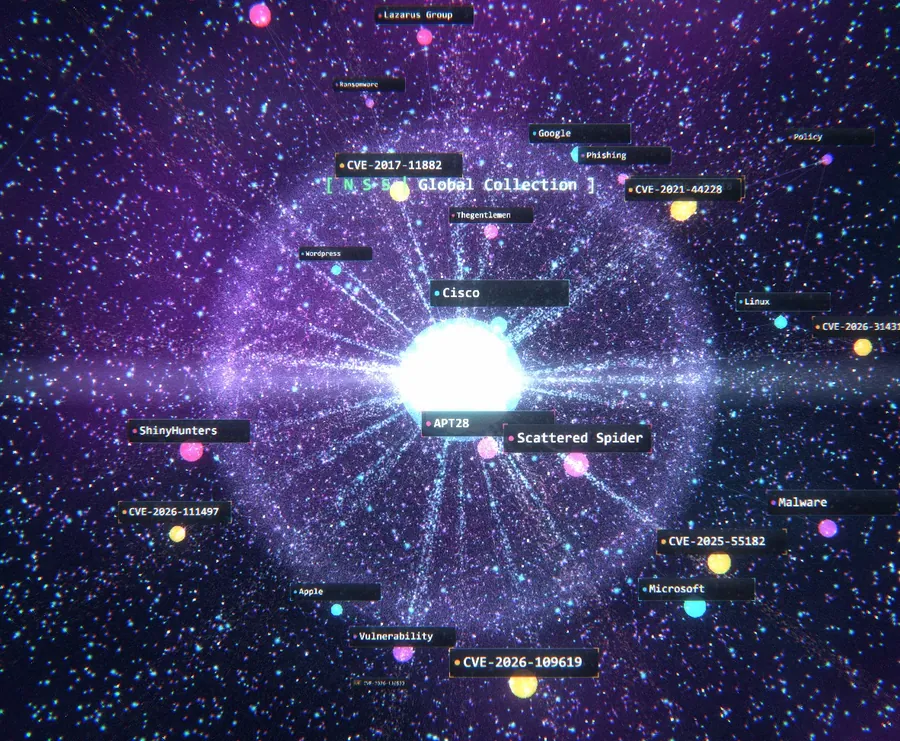
The NSS global collection view: live entities such as actors, CVEs and vendors orbiting the collection coreSee the live collection