Technical analysis NSS-ZM-01TLP:CLEAR
Found by NSSPage, installer and server traced by NSS; 9 of 9 on no list NSS holds
Fake Zoom update page installs a self-hosted ScreenConnect client: technical analysis
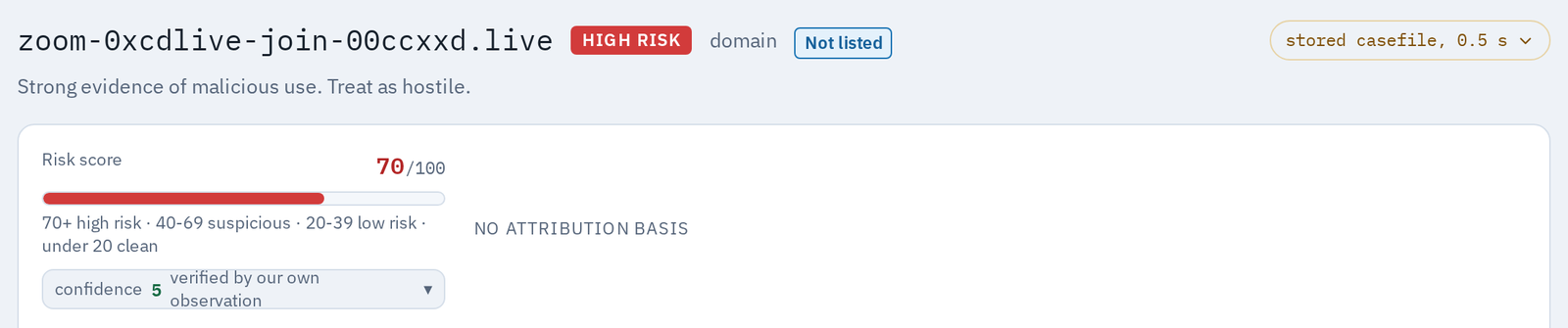
A page made to look like a Zoom meeting tells the visitor their app is out of date and offers an update. The update is a ScreenConnect remote-access client set to call a server its sender runs; whoever runs it hands over control of their computer. NSS took the page from the day's new registrations, captured it, read the installer and traced it to that server within 23 hours of the page's registration. The server's domain was registered 63 days before the lure. None of the nine indicators was on any list NSS holds on 12 November 2026.
- Published
- Last updated
- Reading time
- 8 min
- Marking
- TLP:CLEAR
- of the 9 indicators on any list NSS holds
- 0
- from lure registration to its server and file hash
- 23 h
- server behind the download portal and the relay
- 1
- by which the connect-back domain is older than the lure
- 63 days
Key findings
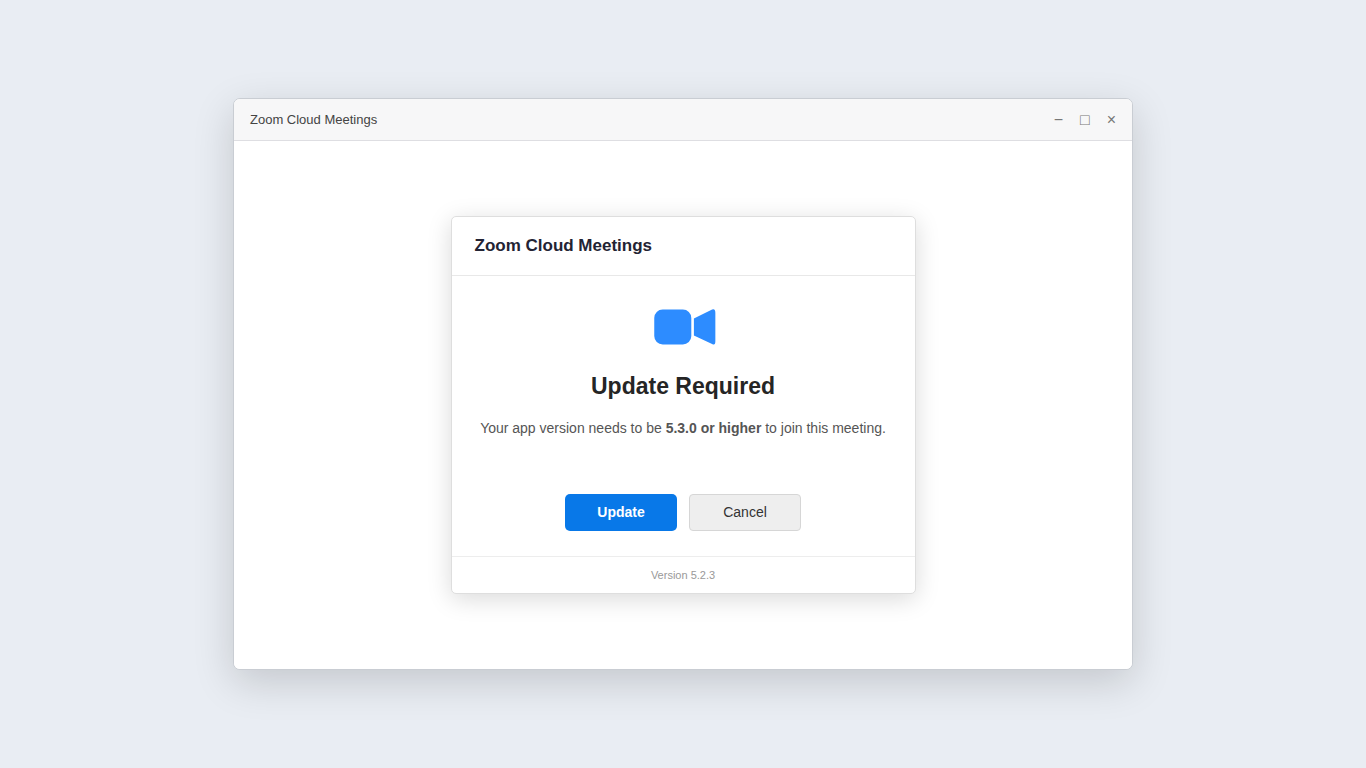
- The page zoom-0xcdlive-join-00ccxxd[.]live, registered on 11 November 2026 at 14:31 UTC, shows a fake "Zoom Cloud Meetings" window: "Update Required. Your app version needs to be 5.3.0 or higher to join this meeting." It served the same page to a desktop, a phone and a crawler.
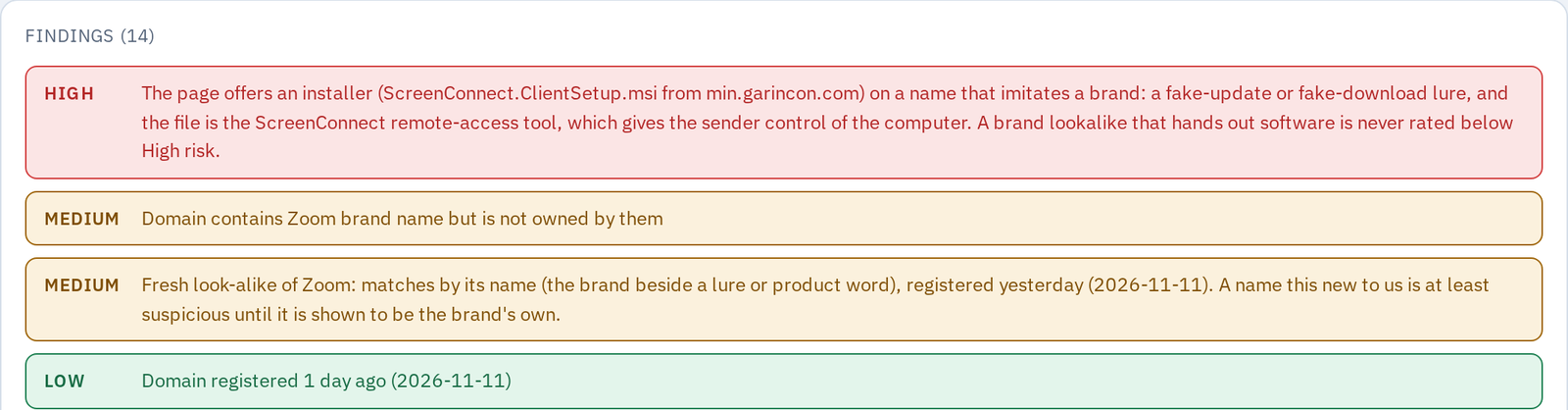
- The Update button downloads ScreenConnect.ClientSetup.msi from min[.]garincon[.]com. The file is a ScreenConnect remote-access client: 15,216,640 bytes, SHA-256 c98e783442a4ca72244f3bb1d5f8ad28bc1f3f94db8a5afac9597a7c870ca590. Two fetches gave the same file.
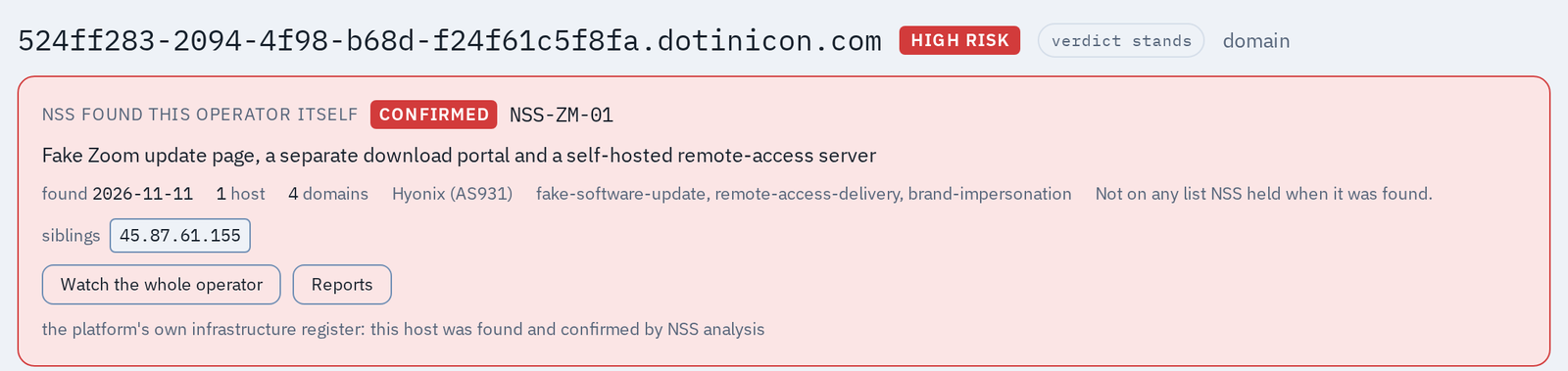
- The client is set to connect back to 524ff283-2094-4f98-b68d-f24f61c5f8fa[.]dotinicon[.]com on port 8041. Anyone who runs it hands remote control of their computer to whoever runs that server.
- One server sits behind both names. The connect-back host resolves to 45[.]87[.]61[.]155, which had ports 8041, 443 and 80 open on 12 November. Asked by address on port 443, it serves the same portal page as min[.]garincon[.]com, behind a content-delivery origin certificate issued on 13 October, the day garincon[.]com got its first certificate.
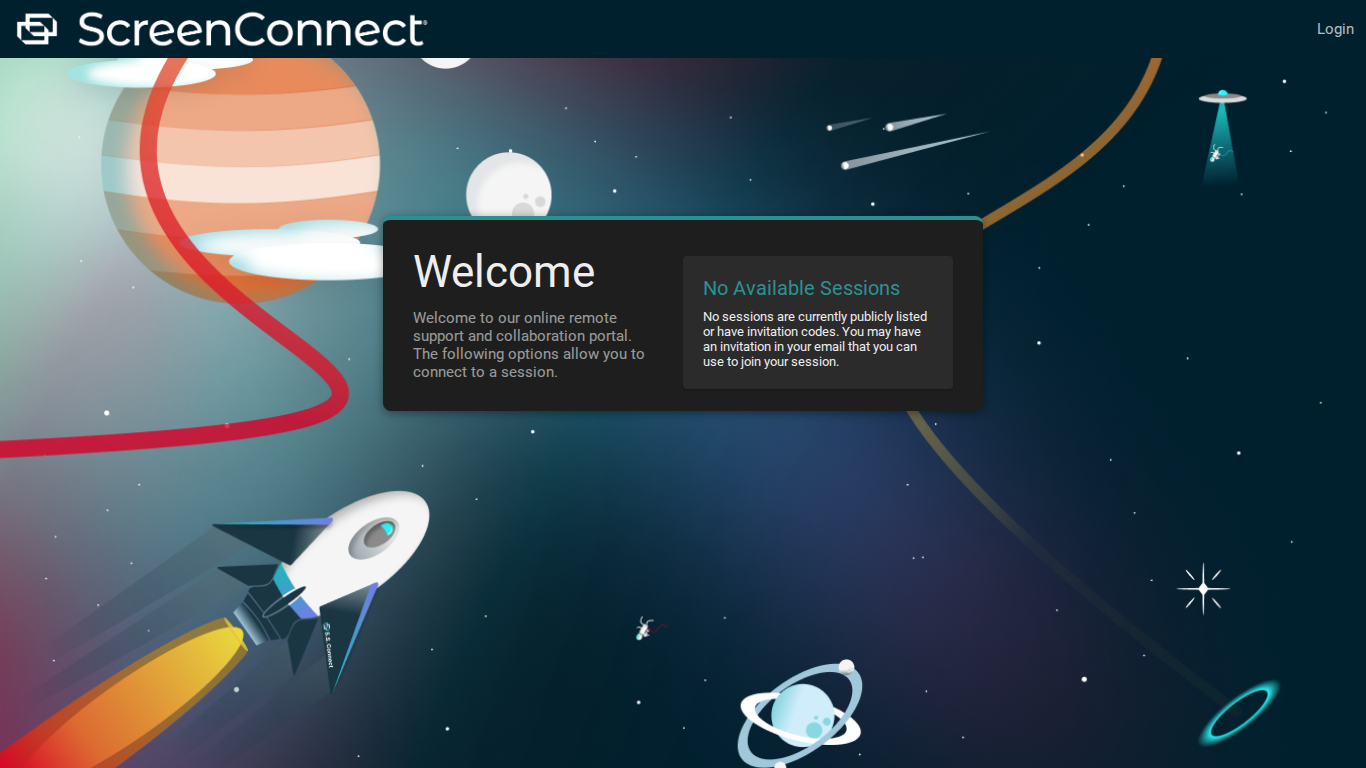
- min[.]garincon[.]com is not a file store. It is a self-hosted remote-access portal ("Welcome to our online remote support and collaboration portal"). The sender runs their own instance of the product rather than borrowing anyone's account.
- The two operator domains were bought at the same registrar a month apart: dotinicon[.]com on 9 September and garincon[.]com on 12 October 2026. The lure page was bought on 11 November, at a different registrar, and placed on a shared hosting platform.
- None of the nine indicators was on any list NSS holds when this paper was written. NSS now rates the page, both download names, both connect-back names and the server address High risk 70.
Timeline
- 9 Sep 2026, 14:52dotinicon[.]com is registered. It will hold the connect-back host.
- 12 Oct 2026, 17:51garincon[.]com is registered at the same registrar.
- 13 Oct 2026Certificates for garincon[.]com (12:28) and an origin certificate on the server 45[.]87[.]61[.]155 (16:14).
- 11 Nov 2026, 14:31The lure page zoom-0xcdlive-join-00ccxxd[.]live is registered. Its first certificate follows 23 minutes later.
- 12 Nov, 04:08The name arrives in NSS's next daily list of new registrations. NSS resolves it, and the brand rule matches Zoom beside "join".
- 12 Nov, 04:34NSS captures the page and records the installer link. The first casefile reads Suspicious 40.
- 12 Nov, about 10:07NSS adds a rule: a brand look-alike that offers an installer is rated malware delivery. The page and the download host move from Suspicious 40 to High risk 70.
- 12 Nov, 13:11NSS fetches the installer once through its probe and reads where it connects. The connect-back host, its domain and the server move to High risk 70: 22 hours 40 minutes after the lure was registered.
How the lure works
The page draws a desktop window titled "Zoom Cloud Meetings" inside the browser, with the Zoom camera icon and a version line, "Version 5.2.3". It says the visitor's app must be 5.3.0 or higher to join the meeting. There are two buttons. Update is a plain link to the installer. Cancel only shows a message.
The page needs no script to do harm, asks for no password and sets no cookie. It is 8,912 bytes and was the same for a desktop, a phone and a crawler, so it does not hide from scanners. Its harm is the file.
How visitors reach it NSS did not see. A name like this, with "join" and a meeting-style code in it, is made to sit in a meeting invitation sent by email or message.
The installer
NSS fetched the file once on 12 November at 13:11 UTC through its probe, took its hashes, read its settings and deleted it. It was never run.
| Property | Value |
|---|---|
| File name | ScreenConnect.ClientSetup.msi |
| Size | 15,216,640 bytes |
| SHA-256 | c98e783442a4ca72244f3bb1d5f8ad28bc1f3f94db8a5afac9597a7c870ca590 |
| MD5 | e6142c9c458795d1fea5e18288c1adfb |
| Kind | Windows Installer package, author "ScreenConnect Software" |
| Client id | 230f9b38c3c088fe, installed as the service "ScreenConnect Client (230f9b38c3c088fe)" |
| Connects to | 524ff283-2094-4f98-b68d-f24f61c5f8fa[.]dotinicon[.]com, port 8041 |
ScreenConnect is a legitimate remote-support product. Here it is used as the payload: once installed, the client calls the sender's server and waits to be controlled. No exploit is needed, and security tools that trust remote-support software may let it run.
One server behind the names
Three records tie the download host and the connect-back host to one server, 45[.]87[.]61[.]155:
- The connect-back host resolves to it, and its relay port 8041 was open on 12 November.
- Asked by address on port 443, it serves the same portal page that min[.]garincon[.]com serves through a content-delivery network, with the same page title.
- It presents that network's origin certificate, issued on 13 October 2026, the day garincon[.]com received its first public certificate.
So the sender runs one self-hosted instance of the product. Its web portal is reached as min[.]garincon[.]com behind the delivery network, and its relay is reached directly as a long random host name under dotinicon[.]com. The two operator domains were bought at the same registrar, a month apart, and both use the delivery network's name servers.
Seen before: the same method in public reporting
NSS Hunt searched NSS's library of past reporting for the same lure and the same tool. The method is not new. These public reports describe it, closest first:
| Reported | Who, as reported | Lure | Payload | How close |
|---|---|---|---|---|
| Aug 2026 | SMOKE#SCREEN campaign, no named group | Fake Zoom updates, then business documents | Legitimate ScreenConnect client for remote control, on Windows and macOS | Same lure, same tool |
| May 2026 | A criminal campaign, no named group | A fake meeting invitation, then a fake Zoom update | ScreenConnect installer served from the sender's own server | Same lure, same tool, same self-hosted delivery |
| Sep to Oct 2026 | Several criminal campaigns, no named group | Event invitations, fake meeting invitations, payment notices, shared dashboards | Rogue ScreenConnect clients, one paired with a second remote-management tool | Same tool, other lures |
| 2026 | Sapphire Sleet, reported as North Korean | A fake Zoom SDK update on macOS | AppleScript that fetches further stages | Same lure, other payload |
| May 2026 | Nimbus Manticore (UNC1549), reported as Iranian | Trojanized Zoom installers and job lures | MiniJunk and MiniFast backdoors | Same lure, other payload |
NSS found none of this paper's names, addresses, file hash or client id in any of these reports, or anywhere else in its records. The match is in method only, so this paper does not link the operator to any group above. What the reports do show is that a fake Zoom update handing out a remote-support client is an established playbook, used by criminal crews for months, and that state groups use the Zoom update lure too.
Lure or test?
The Cancel button on the lure shows the message "You cancelled the demonstration." NSS cannot tell whether this page is a lure kit or an authorised phishing test. Either way, a remote-access client calling an instance you do not own is an incident.
How it maps to ATT&CK
| Technique | What NSS saw |
|---|---|
| T1583.001 Acquire Infrastructure: Domains | Three domains bought between September and November 2026 |
| T1608.001 Stage Capabilities: Upload Malware | The installer staged on the sender's own portal |
| T1036 Masquerading | A web page drawn as a Zoom desktop window and a fake update |
| T1204.002 User Execution: Malicious File | The visitor must download and run the installer |
| T1219.002 Remote Access Tools: Remote Desktop Software | A remote-support client set to connect to the sender's relay |
What a defender can look for
In order of how much each one catches:
- Hunt endpoint records for the SHA-256 above, and for a service named "ScreenConnect Client (230f9b38c3c088fe)".
- Allow only the remote-support instances your organisation runs. A remote-support client that calls an instance you do not own is the finding, whatever the lure.
- Alert on outbound connections to port 8041, and to 45[.]87[.]61[.]155 on any port.
- Block the five names and the installer address in the indicator list at DNS and web proxy.
- Tell staff that Zoom updates come from the Zoom app or zoom[.]us, never from a page that opens from a meeting link.
Do not block the lure page's own address. It belongs to a shared hosting platform that serves unrelated sites.
All nine indicators are in the CSV and JSON files below, and each one opens as a casefile in NSS Investigate.

The NSS tools used
- Discovery
Took the name from the day's new registrations, resolved it and matched it as a Zoom look-alike with a meeting word beside the brand.
- Capture
Loaded the page as a desktop, a phone and a crawler, kept the screenshots and the page source, and recorded the installer link.
- Investigate
Built the casefiles: the registry record, certificates and page for each name, and the verdict High risk 70 for the page, both download names, both connect-back names and the server address.
- Probe
Fetched the installer once, took its hashes, read its connect-back setting and deleted it; then checked which ports the server answers on.
- Hunt
Searched NSS's library of past reporting for the same lure and tool: four earlier patterns, and no shared name, address or file.
- Register
Holds the operation as one entry with its names, server and file, so new names that call the same server join it.
Indicators
All 9 indicators. Each is written defanged so it cannot be opened by accident. TLP:CLEAR. Use them in your own tools; no account needed.
| Indicator | Type | Note |
|---|---|---|
| zoom-0xcdlive-join-00ccxxd[.]live | Domain | The lure page: a fake Zoom update window |
| hxxps://min[.]garincon[.]com/Bin/ScreenConnect.ClientSetup.msi | URL | The installer the Update button downloads |
| min[.]garincon[.]com | Domain | Download host and the operator's remote-access web portal |
| garincon[.]com | Domain | Registered domain of the download host |
| 524ff283-2094-4f98-b68d-f24f61c5f8fa[.]dotinicon[.]com | Domain | Connect-back host set inside the installer, port 8041 |
| dotinicon[.]com | Domain | Registered domain of the connect-back host |
| 45[.]87[.]61[.]155 | IP address | The server behind both: relay on port 8041 and origin of the download portal |
| c98e783442a4ca72244f3bb1d5f8ad28bc1f3f94db8a5afac9597a7c870ca590 | File hash | SHA-256 of ScreenConnect.ClientSetup.msi, 15,216,640 bytes, client id 230f9b38c3c088fe |
| e6142c9c458795d1fea5e18288c1adfb | File hash | MD5 of the same installer |
How we know
What this rests on
- The page text, link and screenshots are from NSS captures on 12 November 2026 at 04:34 and 09:59 UTC; the portal capture is from 10:01 UTC.
- Registration dates and registrars are public registration records. Certificate dates are from the certificates the servers presented and from public certificate logs.
- The file facts are from one fetch on 12 November 2026 at 13:11 UTC, repeated once with the same hash. The file was read, not run.
- "On no list NSS holds" was checked on 12 November 2026 against every list NSS takes in.
What we cannot say
- NSS did not see how visitors are sent to the page, who received it, or whether anyone ran the installer.
- NSS did not run the installer or watch a session. What it does after it connects is from the product's known behaviour, not observation.
- The page's own wording calls it a demonstration. NSS cannot tell a criminal lure from an authorised test.
- "On no list NSS holds" is not "on no list anywhere".
- This paper is not attributed to any named group.
Use and citation
This paper is marked TLP:CLEAR: it may be shared without restriction. Cite as:
Nexus Sentinel Station (NSS), "Fake Zoom update page installs a self-hosted ScreenConnect client: technical analysis", NSS-ZM-01, 12 Nov 2026. https://nsshq.com/research/fake-zoom-update-remote-access
See something wrong? [email protected]
Related topics:Fake software update luresRemote-access tool abuseHow NSS confirms infrastructure
NSS is not affiliated with Zoom, ScreenConnect, or any registrar, hosting platform or network named in this paper. They are named because the page, the file and the public records name them; nothing here says they knew of or took part in the activity.